

The Maurya Empire: Exploring Ancient India's Powerful Dynasty
The Maurya Empire stands out as one of the most important chapters in ancient Indian history. Founded around 321 BCE, the Maurya Empire brought together large parts of the Indian subcontinent under a single rule for the first time. This vast kingdom stretched from modern-day Afghanistan in the west to Bangladesh in the east, and from the Himalayas in the north to parts of southern India. What makes the Maurya Empire so fascinating is not just its size but also its strong government, cultural growth, and the famous rulers who shaped it. In this article, we'll dive into the story of the Maurya Empire in simple terms, covering its rise, key leaders, daily life, and lasting impact.
Imagine a time when India was divided into many small kingdoms, often fighting each other. Then came the Maurya Empire, which changed everything by creating a unified system. This empire lasted until about 185 BCE and influenced everything from art to religion. We'll look at how the Maurya Empire grew, what made it strong, and why it eventually fell. Along the way, we'll see how leaders like Chandragupta Maurya and Ashoka played big roles in making the Maurya Empire a golden age for ancient India.
The Historical Background of The Maurya Empire
To understand the Maurya Empire, we need to go back to the time before it started. Around the 4th century BCE, northern India was home to several kingdoms, with the Nanda dynasty ruling over Magadha, a powerful area in the Ganges plain. The Nandas were strong, but they were overthrown by Chandragupta Maurya, who founded the Maurya Empire. This happened right after Alexander the Great's invasion of India in 326 BCE, which weakened local powers and created opportunities for new leaders.
Alexander's death in 323 BCE left a power gap in the northwest. Chandragupta took advantage of this, gathering an army and pushing out the remaining Greek forces. Legends say he was helped by a wise advisor named Chanakya, also known as Kautilya, who wrote the famous book Arthashastra on how to run a kingdom. The Arthashastra gives us clues about how the Maurya Empire was governed, even though the book might have been finished later.
The rise of the Maurya Empire marked the end of small, scattered states and the beginning of a big, organized empire. It started in Magadha, with the capital at Pataliputra (modern Patna), a bustling city by the Ganges River. From there, the Maurya Empire expanded quickly, thanks to smart military moves and alliances. This background sets the stage for understanding how the Maurya Empire became the first pan-Indian empire, covering most of the subcontinent.
Key Rulers Who Shaped The Maurya Empire
The success of the Maurya Empire owes a lot to its early rulers. Let's look at the main ones who built and expanded it.
Chandragupta Maurya: The Founder
Chandragupta Maurya is the man who started the Maurya Empire around 321 BCE. Born around 340 BCE, he came from humble beginnings but rose to power by overthrowing the Nanda king. With Chanakya's guidance, he built a strong army and conquered lands across northern India.
One of his big wins was against Seleucus I Nicator, a Greek general who tried to take back Indian territories after Alexander. In 305 BCE, Chandragupta defeated him and made a treaty that gave the Maurya Empire control over areas like Afghanistan and Balochistan. In return, Seleucus got 500 war elephants, which shows how important elephants were in ancient battles.
Chandragupta ruled until about 298 BCE. Later in life, he became interested in Jainism, a religion that teaches non-violence. He gave up his throne, went to southern India, and fasted until death at Shravanabelagola in Karnataka. His leadership laid the foundation for the Maurya Empire's growth.

Bindusara: The Expander
After Chandragupta, his son Bindusara took over the Maurya Empire from 298 to 272 BCE. Known as "Amitraghata" or slayer of enemies, Bindusara kept expanding the kingdom, especially southward into the Deccan region. He conquered areas up to modern Karnataka, but stopped short of the far south, where kingdoms like the Cholas and Pandyas remained independent.
Bindusara faced some revolts, like in Taxila, and sent his son Ashoka to handle them. He also kept good ties with Greek kings, showing that the Maurya Empire was connected to the wider world. Bindusara followed the Ajivika faith, an ancient ascetic group. His rule strengthened the Maurya Empire, setting it up for its peak under his son.
Ashoka: The Great Reformer
Ashoka, who ruled from about 268 to 232 BCE, is the most famous leader of the Maurya Empire. He started as a fierce warrior, fighting a bloody war against Kalinga (modern Odisha) in 261 BCE. The battle killed over 100,000 people, and the horror of it changed Ashoka forever. He turned to Buddhism and promised to rule with peace and kindness.
Ashoka spread his ideas through edicts carved on rocks and pillars across the Maurya Empire. These messages talked about dhamma, or moral law, urging people to be kind, respect animals, and avoid violence. He built hospitals for people and animals, planted trees along roads, and sent missionaries to places like Sri Lanka and even Greece to share Buddhism.
Under Ashoka, the Maurya Empire reached its largest size and became a model of good governance. He called himself "Beloved of the Gods" and focused on welfare. Ashoka's changes made the Maurya Empire not just powerful, but also a place where ethics mattered.
After Ashoka, rulers like Dasharatha and Samprati tried to keep things going, but the Maurya Empire started to weaken.
Expansion and Territory of The Maurya Empire
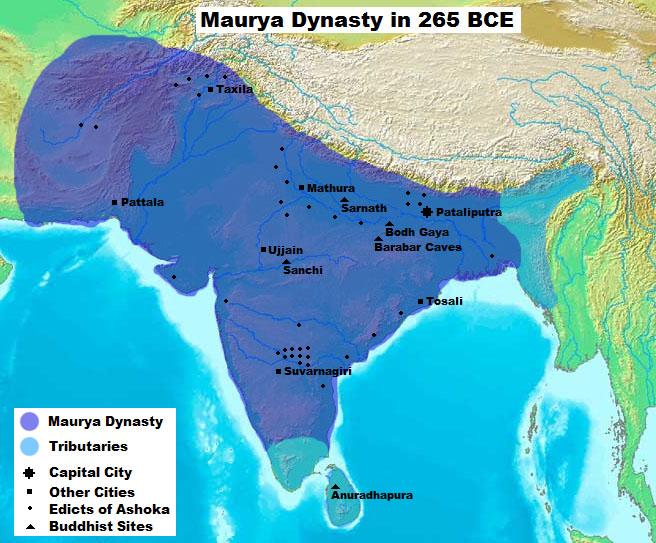
The Maurya Empire grew from a small kingdom in Magadha to a massive empire covering about 5 million square kilometers at its peak. Under Chandragupta, it took over the northwestern areas from the Greeks. Bindusara added southern lands, and Ashoka conquered Kalinga, making the Maurya Empire control from the Hindu Kush mountains to the Bay of Bengal.
The empire didn't rule every inch directly. It had core areas like Magadha, Taxila, Ujjain, and Tosali, connected by roads and trade routes. Peripheral regions paid tribute or had loyal commanders. This network helped the Maurya Empire manage such a big area without modern tech.
Trade routes like the Uttarapatha (northern road) linked the Maurya Empire to Central Asia, while southern paths reached ports. The empire's size made it one of the largest in ancient times, rivaling the Roman Empire.
Administration in The Maurya Empire
Runningthee Maurya Empire was no easy task, but it had a smart system. The king was at the top, helped by a council of ministers called the Mantriparishad. The empire was divided into provinces, each run by a prince or high official.
In cities like Pataliputra, there were boards for things like trade, manufacturing, and taxes. Villages had their own leaders called gramikas. The Arthashastra describes spies who kept the king informed about everything. Ashoka added dhamma mahamattas, officials who taught moral values.
This centralized setup made the Maurya Empire efficient. Taxes came from farms, mines, and trade, funding the army and public works like roads and wells. It was like a well-oiled machine, keeping peace across vast lands.
Economy of The Maurya Empire
The economy of the Maurya Empire was based on farming, trade, and crafts. The fertile Ganges plain grew rice, wheat, and cotton. The state owned much land and collected taxes, often a share of the harvest.
Trade boomed with good roads and rivers. Goods like spices, textiles, and metals went to places like Persia and Greece. Coins made of silver and copper helped business. The empire had mines for gold and iron, and forests provided timber and elephants.
Under Ashoka, rulers protected the environment, such as banning forest fires. This helped farming and trade. The Maurya Empire's economy supported a population of 15 to 30 million people, making it rich and stable.
Military Strength of The Maurya Empire
The Maurya Empire had one of the biggest armies in the ancient world. Greek writers like Megasthenes said it had 600,000 foot soldiers, 30,000 cavalry, and 9,000 elephants. Elephants were like tanks, scaring enemies in battle.
The army was divided into parts: infantry, cavalry, chariots, and elephants. There was even a navy for rivers. Chandragupta used it to conquer, while Ashoka used it less after Kalinga, focusing on defense.
Training was strict, and the king controlled everything through boards. This military power protectedthee Maurya Empire and helped it expand.
Religion and Culture in The Maurya Empire
Religion played a big role in the Maurya Empire. It started in Magadha, where non-Vedic faiths like Buddhism and Jainism were strong. Chandragupta leaned toward Jainism, Bindusara toward Ajivika, and Ashoka toward Buddhism.
Ashoka's edicts, written in Prakrit, Greek, and Aramaic, spread ideas of non-violence and respect. He built stupas and sent monks abroad, helping Buddhism grow worldwide. Culture mixed Indo-Aryan and local traditions, with Sanskrit for learning.
Society had castes, but the Maurya Empire tried to unite people. Women had some rights, but they declined over time. Festivals and arts flourished, making the Maurya Empire a cultural hub.

Art and Architecture of The Maurya Empire
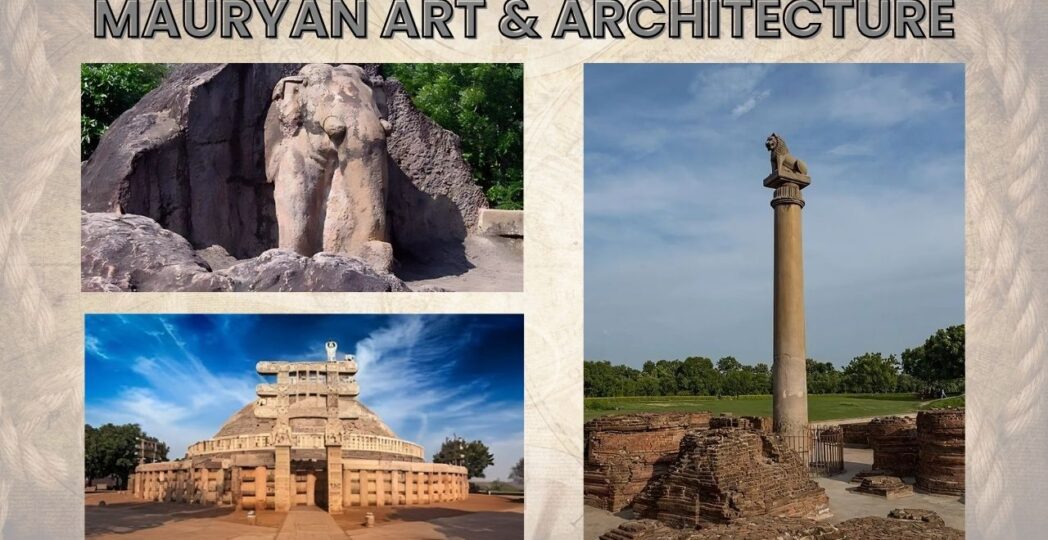
The Maurya Empire left behind amazing art and buildings. Ashoka's pillars, made of polished sandstone, stand tall with animal tops like lions and elephants. The Lion Capital at Sarnath is now India's national emblem.
Stupas at Sanchi and Bharhut hold Buddhist relics, with detailed carvings. Caves like Barabar were cut from rock for monks. Palaces in Pataliputra had wooden halls inspired by Persian styles.
Art showed animals, people, and nature, blending local and foreign ideas. Coins had symbols like trees and elephants. The Maurya Empire's art influenced later Indian styles, showing skill in stone work.

Society in The Maurya Empire
Life in the Maurya Empire varied by place and class. Most people were farmers, living in villages. Cities like Pataliputra had merchants, artisans, and officials. The caste system grouped people into brahmins (priests), kshatriyas (warriors), vaishyas (traders), and shudras (workers).
Tribes were included, but some faced discrimination. Women could own property, but customs like child marriage started appearing. Education was for the elite, with a focus on the Vedas or practical skills.
Ashoka's rules promoted kindness to all, including slaves and animals. Society was diverse, with Indo-Aryans, locals, and foreigners mixing. This made the Maurya Empire a melting pot.
Decline and Fall of The Maurya Empire
After Ashoka died in 232 BCE, the Maurya Empire began to fall apart. Weak kings like Dasharatha and Brihadratha couldn't hold it together. Provinces broke away, and invasions from the Greeks in the northwest added pressure.
By 185 BCE, the last king, Brihadratha, was killed by his general Pushyamitra Shunga, starting the Shunga dynasty. Reasons for the decline include too much central control, high taxes, and Ashoka's focus on peace, weakening the army. The big size made it hard to manage without strong leaders.
The end of the Maurya Empire led to smaller kingdoms, but its ideas lived on.
The Legacy of The Maurya Empire
Even after it fell, the Maurya Empire left a big mark. Ashoka's edicts inspired modern ideas of peace and animal rights. Buddhism spread far because of him, reaching Asia and beyond.
India's emblem and flag draw from Mauryan symbols. The empire showed how to unite diverse people, influencing later rulers like the Guptas. Books like the Arthashastra guide governance even today.
The Maurya Empire reminds us of ancient India's glory, with lessons in leadership, ethics, and unity.
Disclaimer
This article is for educational and informational purposes only. It is based on historical sources and interpretations, which may vary. The content does not represent professional advice, and readers should consult reliable academic resources for deeper study. Views expressed are not intended to offend any religious or cultural sentiments.
References
- Wikipedia: Maurya Empire - https://en.wikipedia.org/wiki/Maurya_Empire
- Britannica: Mauryan Empire - https://www.britannica.com/place/Mauryan-Empire
- National Geographic: Mauryan Empire - https://education.nationalgeographic.org/resource/mauryan-empire
- Khan Academy: The Maurya and Gupta Empires - https://www.khanacademy.org/humanities/world-history/ancient-medieval/early-indian-empires/a/the-maurya-and-gupta-empires
- Lumen Learning: Rise of the Maurya Empire - https://courses.lumenlearning.com/atd-herkimer-worldcivilization/chapter/rise-of-the-maurya-empire
- Students of History: The Mauryan Empire - https://www.studentsofhistory.com/the-mauryan-empire
- TimeMaps: The Mauryan Empire of Ancient India - https://timemaps.com/civilizations/the-mauryan-empire
- LibreTexts: Vedic India to the Fall of the Maurya Empire - https://human.libretexts.org/Bookshelves/History/World_History/World_History_1:_to_1500_(OpenStax)/Unit_1:_Early_Human_Societies/05:_Asia_in_Ancient_Times/5.05:_Vedic_India_to_the_Fall_of_the_Maurya_Empire
- Study.com: Mauryan Empire Art & Culture - https://study.com/academy/lesson/mauryan-empire-art-culture.html
- Vision IAS: The Mauryan Empire - https://cdn.visionias.in/value_added_material/dbf70-the-mauryan-empire.pdf
